sequence explorer · local model
One base
Change one DNA base. Watch how a genome model's expectations shift along the sequence, and keep the model's view separate from what biology has established.
Local experiment · Evo 2 7B · GPU required · exploratory interpretation
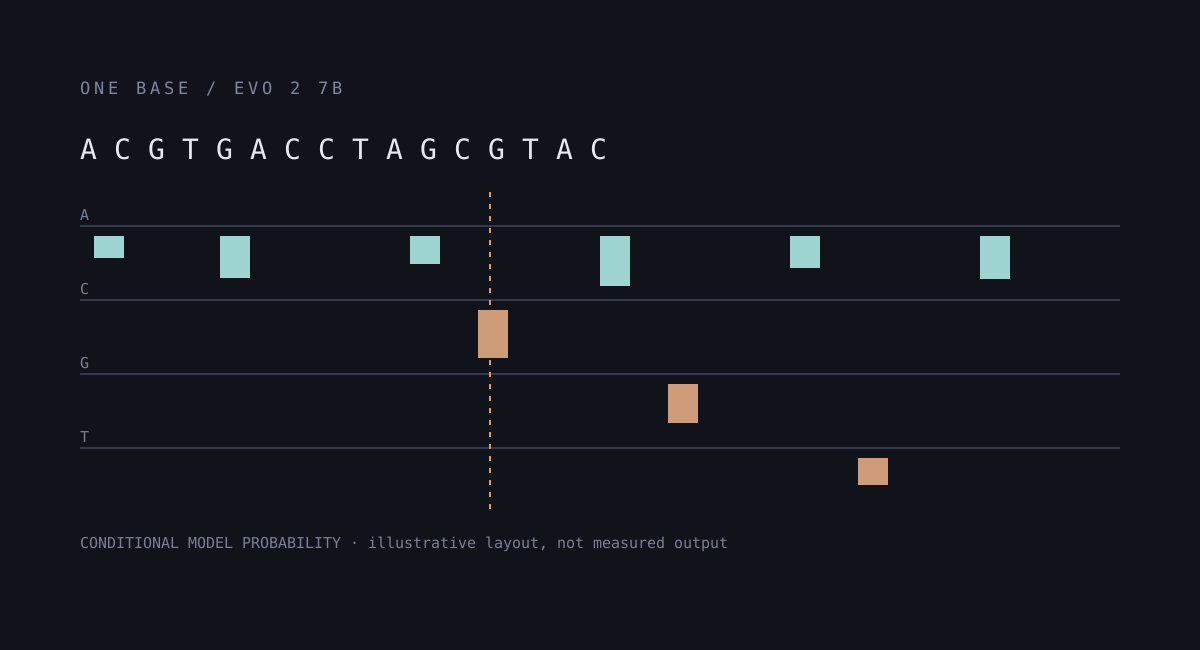
What does one edit change?
The viewer gives Evo 2 a DNA sequence and reads the conditional log-probability it assigns to each observed base, given the bases before it. You can substitute, insert or delete a base, then compare the edited window with its baseline and inspect the A, C, G and T alternatives.
Before editing, notice that each position is predicted from its left context. The first position has no preceding base. After an edit, the display reports how much the score floor shifts even away from the mutation: the model processes the whole window in finite precision, so small changes can move many values.
What the score means
These are conditional probabilities from a learned sequence model. They are not a measure of organismal fitness, expression, pathogenicity or evolutionary success. A model may find a sequence surprising without that sequence being harmful; interpretation requires biological controls and independent validation.
The page uses an example sequence shipped with the Evo 2 package's test prompts. Reading frames shown in the viewer come from a standard-code scan; the demo does not assert gene annotation. The small number of windows explored so far do not establish general conclusions.
Run it on your machine
The viewer runs locally with the upstream Evo 2 package and a CUDA-capable GPU with enough memory for the 7B model. Start python server.py and open http://127.0.0.1:8770. It binds to localhost; no sequence is sent to this website. Local receipts record sequence hashes and interaction metadata, not raw sequence text.
This loop is part of Palimpsest, a local workshop for learning through model experiments. The separate repository makes this one experiment easier to find and run.