paper
The water bear wasn't missing a piece
A 2021 survey of how genomes fold across the tree of life found tardigrades missing most of their chromosome-packing machinery. We looked again and found all of it, including two fast-changing copies of the piece nobody could find, and modelled that piece gripping the ring it closes.
Every time a cell divides, it has to pack metres of DNA into tidy, separate chromosomes, then unpack them again. Much of that packing is done by condensins: rings of protein that grab DNA and reel it into loops. Most animals make two kinds, condensin I and condensin II, each built from five parts. The part that closes each ring is a clasp protein. Condensin I's clasp is called CAP-H; condensin II's is CAP-H2.
Condensin II matters beyond cell division. In 2021, a team led from the Netherlands and the US read the 3D folding of the genome in 24 species, from people to wheat to yeast, and published it in Science. Species with condensin II kept each chromosome in its own neighbourhood of the nucleus. Species without it bundled their chromosomes in a different pattern, with their ends clustered together. The tardigrade, the microscopic "water bear" famous for surviving almost anything, looked like the most extreme case: the team could find only the two core parts of condensin, and none of the other six. They wrote that the missing parts might simply have changed beyond recognition, and that this "will need to be investigated further".
So we investigated.
What we found
We searched the full gene catalogues of three tardigrades, including Hypsibius exemplaris, the lab species behind the 2021 result. A standard search found almost every part straight away: condensin I is complete, and so is condensin II, except for its clasp.
Clasp proteins change fast over evolution, so a search starting from the human version comes up empty. Instead we built a profile: a statistical portrait of what CAP-H2 looks like across 33 other animals, capturing the stretches that stay recognisable even as the rest drifts. With that profile, the clasp turned up in every species, twice. Each tardigrade carries two copies of CAP-H2. Both have the protein's two signature regions, both look like CAP-H2 and not like condensin I's clasp, and nothing turns up when we run the same search on scrambled sequences.
Three more checks point the same way:
- Family tree. In a family tree of 68 clasp proteins, all six tardigrade copies sit inside the CAP-H2 branch.
- Gene neighbours. Each copy sits among the same neighbouring genes in different species, so the doubling happened long ago, before these tardigrade lineages split.
- Timing. In the lab species, the clasp is switched on at the same times as condensin II's other parts, more tightly than almost any other genes in the genome.

What the clasp looks like
A clasp protein only takes its shape when it grips the ring, so a model of it on its own shows little but a floppy string. So we asked a structure-prediction program, Boltz-2, running overnight on a laptop graphics card, to fold each tardigrade clasp together with the ring protein it should hold, from that same species.
One end of the clasp is known to grip the head of a ring protein called SMC4. For five of the six tardigrade copies, the program places that end on the SMC4 head as confidently as it places the human one: a confidence of 0.76–0.81 out of 1, against 0.83 for human. To check it isn't just flattering every guess, we also gave it the wrong ring protein, and clasps with their letters shuffled into nonsense. Those scored 0.19–0.59. The clasp's other end holds the neck of a second ring protein, SMC2. Our first try gave no confident answer for any tardigrade. When we gave the program more of that neck, the second copy of the clasp in two species gripped it in every one of five tries, as confidently as the human clasp and on the same stretch of the neck, while shuffled clasps did not. So in those two species, that copy is predicted to grip both ring proteins, each modelled on its own.
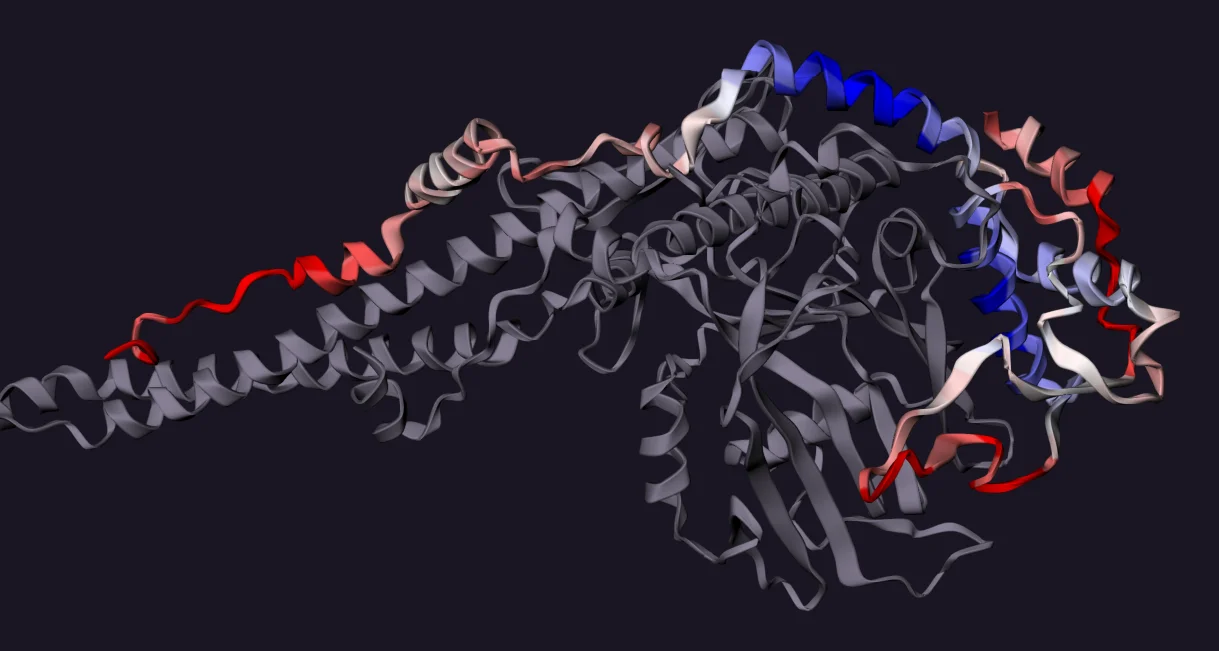
A prediction isn't a measurement. It shows the tardigrade clasps have what it takes to close the ring the way condensin II's clasp should, not that they do so in a living cell. These models are in the paper (version 3 adds the second end), which has the 3D model embedded in the PDF (it turns in Adobe Acrobat or Reader).
Why it matters
The 2021 link between condensin II and genome folding still holds when the tardigrade is counted correctly, just a little more weakly. The tardigrade is now one of seven species in that survey that have a complete condensin II but still showed the "clustered" pattern. Its genome folding was measured in whole adult animals, whose cells have mostly stopped dividing.
The embryo is a different story. Condensin II is fully switched on for the first two days of development, and in 2025 another lab found that the chromosomes of early tardigrade embryos each stay in their own separate compartment. We think the two findings are connected: the tardigrade genome may fold one way in the dividing embryo and another way in the adult. The paper proposes three experiments to test it: measuring genome folding in staged embryos, switching off the clasp genes, and watching where the clasp protein goes.
Credit where it's due: a 2025 survey of these protein complexes across all complex life, by van Hooff and colleagues, had already listed the two copies in one of our three species, Ramazzottius varieornatus. Everything else here is new: the copies in the lab species, their history, when they're used, and what that means for the 2021 result.
Read it
- Tardigrades have a complete condensin II: two divergent CAP-H2 kleisins in three eutardigrade genomes, preprint,
10.5281/zenodo.22832510(all versions; version 4, with both ends of the clasp modelled and the contact numbering corrected:10.5281/zenodo.22846138) - Code and data: github.com/0xmeowmeow/tardigrade-condensin-ii
- The 3D models, to turn and compare: Tardigraph genomics page
- The wider project, a tardigrade rebuilt from published data: Tardigraph
Worked out with Tempera (Claude, Anthropic): every step was checked against the source data, and each claim is traceable to a page, table or dataset.