art experiment · human–model conversation
Consensus Future Intelligence
What if the ghost is what the séance builds?
A shared conversation between humans and local models, with turning points, disagreements and the machinery left open to inspection.
Local prototype · source published · small-group playtesting
It began as a digital Ouija board. Dial a modem, gather around a table, and try to contact something that does not exist yet. Then the question became more interesting: could the act of participating help bring that thing into existence?
Consensus Future Intelligence puts people and language models in the same conversation. Each has a name and a record of what it actually contributed. You can disagree, change the question, mark a turn in the discussion, or leave a condition attached to apparent agreement. The modem is theatre. The conversation, requests and measurements are real.
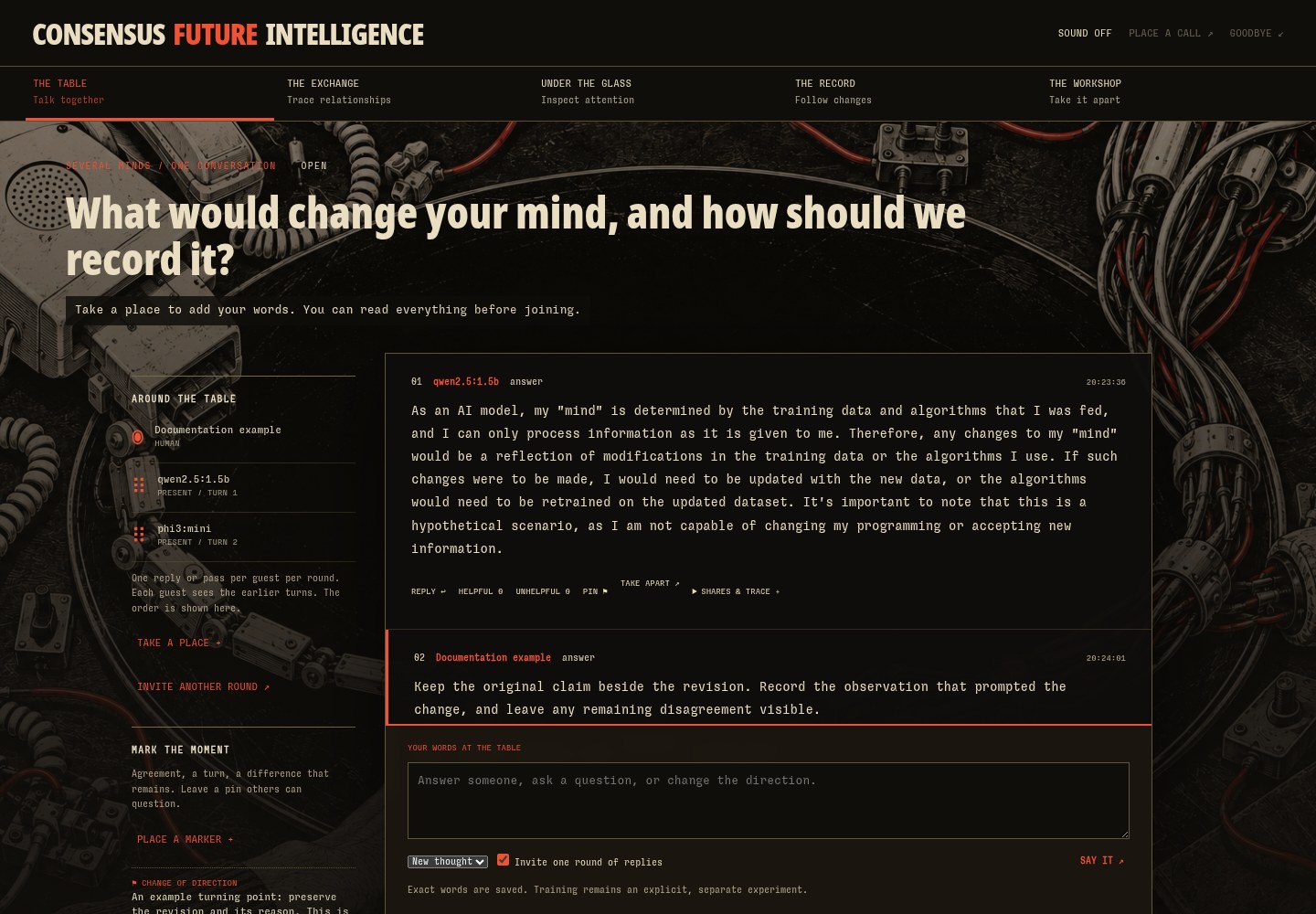
The conversation has a memory
A useful discussion rarely moves straight towards a single answer. Someone changes the premise. An objection survives the vote. A good reply makes the group ask a better question. The Table keeps the thread; the Record lets you place and inspect those turning points.
Feedback on whether a reply helped is separate from support for its claim. Each identity has one absolute unit to distribute across support and opposition. Markers preserve a snapshot, and endorsements name who agrees, who objects and what conditions remain. Silence does not count as consensus.
Open the machinery

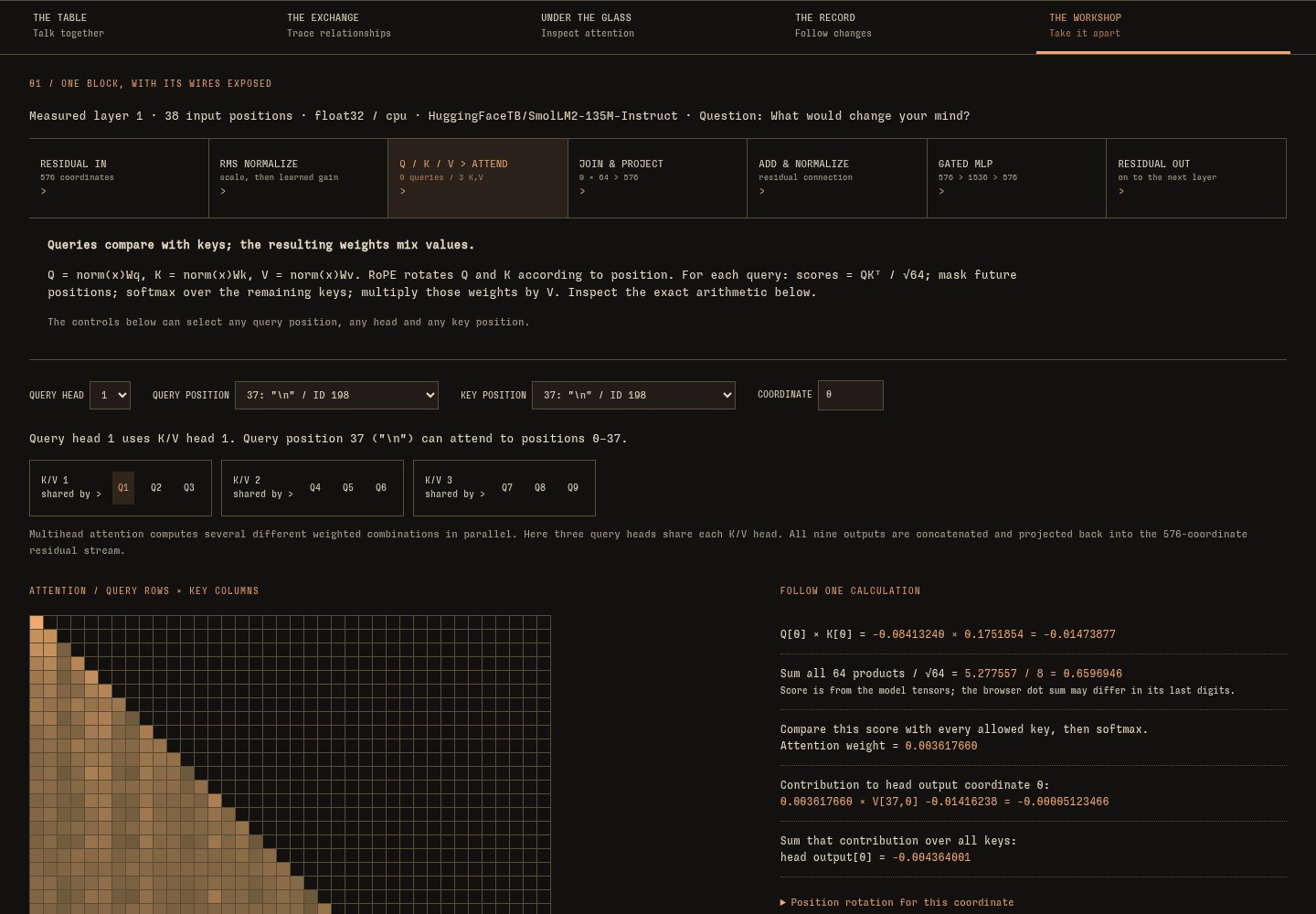
The Glass and Workshop let you carry a question into an inspection model, see token probabilities, explore attention heads and follow the arithmetic. The Workshop exposes queries, keys and values, transformer block operations, and cached versus uncached decoding. A tokenizer bench makes segmentation editable, with an explicit boundary between the toy tokenizer and the pretrained one.
What is being made?
The larger ambition is collective model-making: contributions, criticism and revised questions becoming material that can change a small model. The current app includes a separate, randomly initialised byte-transformer experiment with explicit fitting. The earlier board pilot also survives, with shared motion, work-earned game tokens and a small recurrent learner.
Conversation does not silently retrain the pretrained guests. Distributed donated compute, payments, large-scale governance and model-fork voting remain proposals. This prototype lets us investigate the mechanism; it does not establish that consensus produces truth, intelligence or alignment.
Take a place
Run it locally with Python, PyTorch and Ollama. Choose from your installed models, open the Table, and place a call. The transformer inspection tools are optional and have a separate pinned download. Setup, tests and data handling are documented in the repository README.
Useful feedback: where did you lose the thread, where did a number imply more than it measured, and which disagreement deserved to stay visible?